
Walker Railey

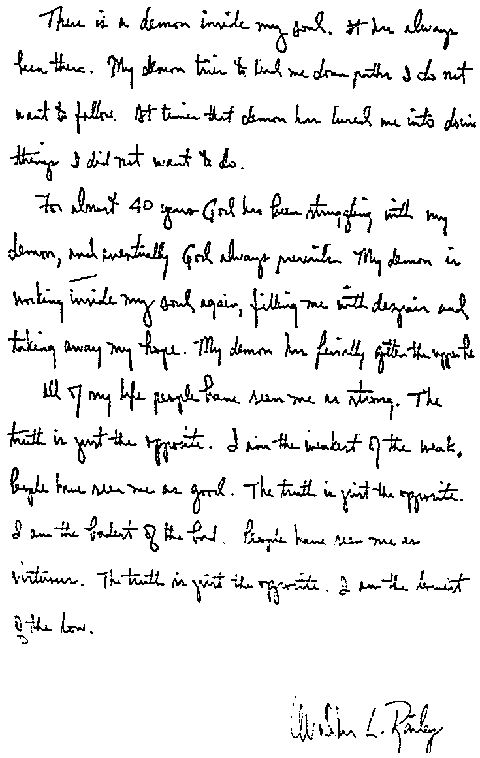
Initial Impression of this writing
The outstanding characteristic of this writing is its control and tension, indicated by the writer's struggle to maintain verticality, angularity in letter forms and along the baseline, plus narrow letters, all revealing self-control and emotional repression, and the compulsive personality type.
Analysis of principle features
The writer's attempt to maintain a vertical slant reflects his effort to adopt a detached or impersonal attitude, positively characterized by independence and restraint, but negatively by self-centeredness and rigidity. This aloof and impartial demeanor, reinforced by wide spacing between lines, reveals someone resisting the influence of both outside forces and inner emotions, preferring to rely on reason. His is an artificial or escapist attitude, including suppression of emotion rather than absence of emotion.
The writer's emotional susceptibility is found in both the fluctuating middle zone size and baseline, depicting emotional pressure on the writer for which there is no release.
Equally, the diminished and sometimes near threaded middle zone, small compared to upper and lower zones, together with an insignificant and defensive ppI, represent his weak self-image.
The considerable difference in length of upper and lower zones over middle zone portrays the writer's never resting ambitions, interests and goals at the outer limits of his ability to achieve. This causes restlessness and dissatisfaction with his life. The handwriting's poor impulse rhythm further suggests the writer is uncomfortable with his inner nature.
The writer's energy is primarily funneled into the area of his demanding conscience, represented by the dominating upper zone, as well as middle zone angularity and contraction of middle zone letters, particularly of ovals. His ambitions and beliefs control his life. However, upper zone covering strokes and middle zone vowel covering strokes point to the existence of the writer's hypocrisy in these areas of life.
Offsetting upper zone dominance is the long, pressured lower zone, sometimes with full loops denoting a strong sexual drive, sometimes blunt ended denoting frustration of that drive. Preoccupation with instinctual forces is reinforced by middle zone letters and terminals which drop into the lower zone.
High form level, angularity and regularity in arrangement and pressure reveal that the writer possesses good intelligence, hard working qualities, and above all, the perseverance necessary for success in his chosen occupation. Tepee formations in the t-stems and strong t-bars with horizontal pressure indicate the writer's perseverance verges on stubbornness in the face of obstacles or adversity.
In his work life, the small angular writing, together with careful punctuation and precise i-dots, portray the writer's good concentration, his hard working and responsible qualities, one who doesn't shun the drudgery of detail. Connected writing reflects his consistency of thought and single-mindedness. He tackles problems at hand in a direct, practical way, and is unhampered by sentimentality or ties to the past, as shown by lack of either lead-ins or excess flourishes in letter forms. He is purposeful and disciplined as expressed in the overall regularity of the writing.
His social behavior, although outwardly friendly or at least impartial, shown by small garlands together with verticality, mask a dogmatic viewpoint, as revealed by baseline angularity and some downward terminals and t-bars. His detached demeanor is reinforced by wide interlinear and interword spacing. The tall upper zone, d-stems in particular, depict ambition tinged with arrogance. In addition, the tall upper zone speaks of scholarly and philosophical pursuits, and the idealist who expects perfectionist standards of himself.
The compressed quality of the writing, together with largely missing or down reaching (counterstrokes) terminals, show that in close, as well as casual relationships, he is selfish and ungenerous. Closed or retraced ovals and narrow interletter spacing reflect limited sharing of his true feelings. Ink-filled ovals suggest occasional explosions of verbal temper because of emotional tension and frustration. Strong t-bars with horizontal pressure express his authoritative nature and the imposition of his will on others. These characteristics combined with precise, strong i-dots, many directly over the i, indicate he is emphatic in what he says and does. The potential for cruelty is evident in the blunt endings of many downstrokes or counterstrokes.
Left tendencies balancing right tendencies testify to a personality divided and held in tension between introverted and extroverted qualities. Such tendencies, together with narrow letters and moderately quick writing, describe the cautious and inhibited individual, pulled equally between the inner forces of his nature and outer forces of his environment.
Summary
In summary, we have a writer torn between the opposing forces of idealism and conscience versus frustrated instinctual drives. The battle between the two results in an overcontrolled personality, uncomfortable with himself, paying the price for bottling up his emotions and natural instincts with possible unpredictable eruptions of emotion.
---oOo---
The writing sample is a photocopy of newspaper printing of uncertain quality. Pressure is inferred from the overall appearance of the sample.
The outstanding characteristic of this writing is its control and tension, indicated by the writer's struggle to maintain verticality, angularity in letter forms and along the baseline, plus narrow letters, all revealing self-control and emotional repression, and the compulsive personality type.
Analysis of principle features
The writer's attempt to maintain a vertical slant reflects his effort to adopt a detached or impersonal attitude, positively characterized by independence and restraint, but negatively by self-centeredness and rigidity. This aloof and impartial demeanor, reinforced by wide spacing between lines, reveals someone resisting the influence of both outside forces and inner emotions, preferring to rely on reason. His is an artificial or escapist attitude, including suppression of emotion rather than absence of emotion.
The writer's emotional susceptibility is found in both the fluctuating middle zone size and baseline, depicting emotional pressure on the writer for which there is no release.
Equally, the diminished and sometimes near threaded middle zone, small compared to upper and lower zones, together with an insignificant and defensive ppI, represent his weak self-image.
The considerable difference in length of upper and lower zones over middle zone portrays the writer's never resting ambitions, interests and goals at the outer limits of his ability to achieve. This causes restlessness and dissatisfaction with his life. The handwriting's poor impulse rhythm further suggests the writer is uncomfortable with his inner nature.
The writer's energy is primarily funneled into the area of his demanding conscience, represented by the dominating upper zone, as well as middle zone angularity and contraction of middle zone letters, particularly of ovals. His ambitions and beliefs control his life. However, upper zone covering strokes and middle zone vowel covering strokes point to the existence of the writer's hypocrisy in these areas of life.
Offsetting upper zone dominance is the long, pressured lower zone, sometimes with full loops denoting a strong sexual drive, sometimes blunt ended denoting frustration of that drive. Preoccupation with instinctual forces is reinforced by middle zone letters and terminals which drop into the lower zone.
High form level, angularity and regularity in arrangement and pressure reveal that the writer possesses good intelligence, hard working qualities, and above all, the perseverance necessary for success in his chosen occupation. Tepee formations in the t-stems and strong t-bars with horizontal pressure indicate the writer's perseverance verges on stubbornness in the face of obstacles or adversity.
In his work life, the small angular writing, together with careful punctuation and precise i-dots, portray the writer's good concentration, his hard working and responsible qualities, one who doesn't shun the drudgery of detail. Connected writing reflects his consistency of thought and single-mindedness. He tackles problems at hand in a direct, practical way, and is unhampered by sentimentality or ties to the past, as shown by lack of either lead-ins or excess flourishes in letter forms. He is purposeful and disciplined as expressed in the overall regularity of the writing.
His social behavior, although outwardly friendly or at least impartial, shown by small garlands together with verticality, mask a dogmatic viewpoint, as revealed by baseline angularity and some downward terminals and t-bars. His detached demeanor is reinforced by wide interlinear and interword spacing. The tall upper zone, d-stems in particular, depict ambition tinged with arrogance. In addition, the tall upper zone speaks of scholarly and philosophical pursuits, and the idealist who expects perfectionist standards of himself.
The compressed quality of the writing, together with largely missing or down reaching (counterstrokes) terminals, show that in close, as well as casual relationships, he is selfish and ungenerous. Closed or retraced ovals and narrow interletter spacing reflect limited sharing of his true feelings. Ink-filled ovals suggest occasional explosions of verbal temper because of emotional tension and frustration. Strong t-bars with horizontal pressure express his authoritative nature and the imposition of his will on others. These characteristics combined with precise, strong i-dots, many directly over the i, indicate he is emphatic in what he says and does. The potential for cruelty is evident in the blunt endings of many downstrokes or counterstrokes.
Left tendencies balancing right tendencies testify to a personality divided and held in tension between introverted and extroverted qualities. Such tendencies, together with narrow letters and moderately quick writing, describe the cautious and inhibited individual, pulled equally between the inner forces of his nature and outer forces of his environment.
Summary
In summary, we have a writer torn between the opposing forces of idealism and conscience versus frustrated instinctual drives. The battle between the two results in an overcontrolled personality, uncomfortable with himself, paying the price for bottling up his emotions and natural instincts with possible unpredictable eruptions of emotion.
---oOo---
The writing sample is a photocopy of newspaper printing of uncertain quality. Pressure is inferred from the overall appearance of the sample.
Biography of Walker Railey

|
Thumbnail History:
Walker Railey was born in Owensboro, Kentucky, a coal mining town. He was not an athlete or school leader but a good student, well liked. At age 16 he told his mother to call the local preacher, he wanted to give a sermon. From then on there was no doubt Walker would become a preacher. After attending the university in Bowling Green, he went on to Southern Methodist University in Dallas, Texas, where he studied homiletics - the art of preaching. Walker was very ambitious and the career he anticipated did not include his family or home town friends. He met his future wife Peggy when he moved to Dallas. Peggy was very musical at an early age. Walker was attracted to her and she knew he was headed for success. Within seven years he was made senior minister at First United Methodist Church in Dallas. Walker had a fresh style in the church as opposed to the dull dogma of mainstream religious thought. People said he didn't preach a sermon - he preached a drama. Six years after he arrived the church membership went way up to six thousand and the congregation included baby boomers and all the upwardly mobile newcomers to Dallas. Walker was five foot ten, not physically impressive, but he created his own image as a modern man of God. In 1987 he was 39 years old, married to Peggy and with two children, Ryan five and Megan two. Railey liked expensive custom tailored suits and shirts with French cuffs. He was a specialist in weddings and even usurped the duties of professional bridal consultants, choreographed the entire wedding service and gave wonderful wedding sermons. By 1987 he began to feel the strain of all his activities and his personal involvement at every level of the church. In marriage he never helped around the house or with the children but in his sermons he told amusing stories about his family life which some close to him knew not to be true. In 1987 he began to receive threatening, typewritten hate letters, a series of six. These threats did not bring Peggy and Railey closer together. Something had gone wrong in the marriage long before the letters, but both were experienced actors and could rise to any occasion. Each seemed more relaxed when separated from the other. Peggy was shy but strong willed and did not defer to her husband. The church hierarchy and members worried about Railey's safety, especially in the pulpit where he was vulnerable. He had an alarm system set up in his house, including the garage. The Monday after Easter the congregation was relieved because the last threat had not been carried out. Walker was wearing a bullet proof vest. What was puzzling through all this was his lack of fear for himself in the pulpit, but especially his lack of fear for his family. On Wednesday, April 22, 1987, at 12:43 A.M. Railey called emergency, saying, "I've just come in the house. My wife is in the garage and somebody's done something to her." When paramedics arrived Peggy was on the floor, nicely dressed as if going out. Her face and neck was swollen and her skin blue. All her symptoms indicated she had been hanged or strangled. Incredibly she was wearing her glasses. There were no indications of a struggle, no broken fingernails, no bits of skin or flesh under the nails, no scratches on her neck. Walker was behaving strangely. He did not seem upset. Police officers thought, he's too cool. He won't touch her. He did not accompany her to the hospital. As a result of the police investigation, Walker's affair with Lucy Papillon was disclosed. Lucy was a forty-year-old psychologist, divorced with two children, attractive daughter of the former bishop in the Methodist Church. |
Walker's story was he was at the library at Southern Methodist University at the time of the attack. He called his wife twice, using the answering machine, and left a message to lock the garage door, that he would park in front of the house. He stated the time as 12:29. The big question was: why did he go to the library when his family was threatened. It turned out he had spent some time with Lucy Papillon on the night of the attack. Because of inconsistencies in his account, the police looked further into his actions. Then on Friday, May 1, 1987, eight days after the attack, he was found at home, sprawled across the bed, fully dressed, with a handwritten, four-page letter and an empty bottle of prescription drugs. He had supposedly attempted suicide. Friends and followers were devastated. The church community became divided as to Walker's innocence. Whether the confession letter is true or faked, it contains no declaration of love, either for his wife, his children, his mistress or his God. It focuses entirely on his struggles, his feelings. That the demon inside him had won the struggle meant that nothing inside him had suddenly snapped. The life he had pretended to live was a lie. Because Peggy had been alive when the police arrived after the attack, the investigation was muddled. There was less effort in preserving clues and more emphasis on saving her life. Before the grand jury he pleaded the Fifth to all questions. He avoided the police. His story kept changing. People wondered, were there two Walkers, one they knew and one they didn't? Two people who had been on Walker's church staff left for different careers and felt free to comment on him: Walker had a big ego. He bullied those who worked near him. He was a charismatic preacher but they described their working relationship with him as "terror." His intensity and need for perfection made them feel something was wrong with them, they were valueless. In staff meetings he would choose one person to belittle. But he had not always been like that. He had changed within the last year or so. Other people felt he had been under such stress he took it out by verbal abuse which seemed to give him sadistic pleasure. Others saw him as self-centered, manipulative and hypocritical. Some even felt he was having some sort of emotional breakdown during this year. He had many admirers but few close friends. But he suffered the fatal combination of towering ambition, arrogance and a lust for power. Walker then moved to San Francisco. He could find only menial work and owed money everywhere. He gave his children up to friends and filed for divorce from Peggy. Three years after the attack the police were no nearer to solving the crime. In 1992 he became chief of staff of Immanuel Presbyterian Church in Los Angeles. Five years had passed since the attack. Finally the Dallas police arrested Walker in Los Angeles. New technology located the exact places where Railey had telephoned from his mobile phone on the night of the attack. FBI tests confirmed that the threatening letters were written on the church office typewriter. DNA of saliva on letters matched Railey's. In the trial the jurors deliberated three days to reach a verdict: guilty but not beyond a reasonable doubt. Railey insisted to the end that he didn't know who perpetrated the attack or wrote the menacing letters. Based upon facts reported in The Dallas Morning News articles and The Demon Inside, by Barbara Wedgwood Guest Analyst: Rosemary Arnold, CG . |
