
Edna St. Vincent Millay
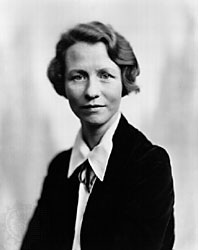
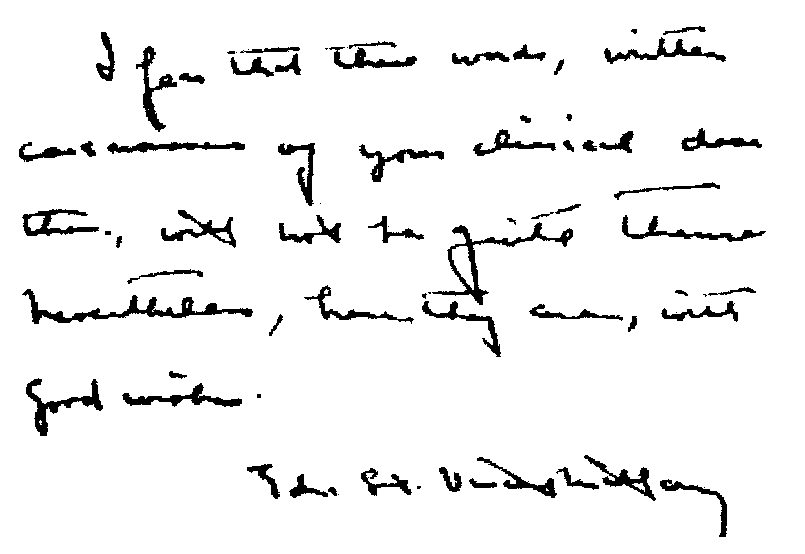
At the age of 18 Edna Millay wrote a magnificent poem, Renascence. In it, she fantasizes an experience of "leaving the body," to partake of Infinity, God, Nature, etc. Following are 5 excerpts from this poem, out of context certainly, but the use I shall make of them will do no injustice to the poem as a whole.
1. And all I saw from where I stood
was three long mountains and a wood.
Over these things I could not see;
These were the things that bounded me; (ll. 9-12)
2. I scrammed, and lo Infinity
came down and settled over me; (ll. 29-30)
3. All sin was of my sinning, all
atoning mine, and mine the gall
Of all regret. Mine was the weight
Of every brooded wrong, the hate
That lay behind each envious thrust,
Mine every greed, mine every lust. (ll. 55-60)
4. Ah, awful weight! Infinity
Pressed down upon the finite Me!
5. And he whose soul is flat the sky
will cave in on him by and by. (ll. 204-205)
Now I shall make four citations from one of her biographers (Joan Dash, "A life of One's Own," Harper & Row, 1973).
6. "... she wants not only to escape from the hills and woods that make her feel imprisoned, but to become one with the sea, to dissolve in it...Screaming to God for death by drowning... 'Mine is a body that should die at sea'" (p. 195).
7. She had a "constant headache for over a year...that stayed with her whenever she was writing" (p. 189).
8. In 1944, in Millay's own words, she had "'an all but life-size nervous breakdown'" (p. 216).
9. She was a "neurotic woman, death-haunted, claustro- phobic, and sexually ambitious" (p. 172).
I now invite your attention to of her handwriting, with which I will make some correlations to both the references from the poem and Dash's book (34).
Read again citations 2, 4, and 5, and then note the "flatness" of the middle zone of her script. There is much thread there, showing that she felt "pressed" down from both sides of life the material and the ideational (spiritual). When the thread is relieved by letter-forms, they are very small and clogged with ink, a sign of great sensuousness, averred by the last phrase of citation 9.
Note the high-flying upward-tending t-bars, signs of vital awareness of "Infinity" or the ideational. At the same time, consider the intense pressure of the lower zone downstrokes. Here are seen signs of a fundamental conflict in her nature great material desires, and an almost ethereal sense of the abstract. Is it any wonder, with this conflict, that she had a constant headache for over a year (citation 7), and was death-haunted and claustrophobic (citation 9), which, along with other implied nervous system disorders, led to a nervous breakdown (citation 8)?
Despite the generally good arrangement of the script there are nice wide spaces between lines the lower zone with its driving, almost demonic force, invades the upper zone of the lower lines, indicating primacy of her "animal" over her "spiritual" nature. She was thus under a very strong, ubiquitous tug-of-war between these two fundamentally different sides of life. An evaluation of guilt feelings can thus be made from this aspect of her script, to which she testifies in her own words (citation 3); she felt responsible for the sins of the whole world!
But the final stroke(s), literally as well as figuratively, is seen in those violent heavy back-slashes 4 of them, in this short script. That 2 of them are in her signature is particularly revealing. It is as if she were trying to blot out her existence, screaming for death or dissolution, as citation 6 puts it. That she wanted to die by drowning, specifically, is not of course, revealed by the handwriting, but this wish takes on new significance in light of her script. Since she feels inextricably "bounded" (citation 1) by land, corresponding to the graphic "boundedness" that has been mentioned, the sea is a fitting place to bring about the desired oblivion. Also, the "empty expanse" of the wide interline spaces, in which the t-bars are "immersed," represent her aim of escaping the domination of practical existence, seen in the flattened middle zone. This is particularly true of the backward strokes which jut up via great spurts of energy from life on this "plane" to absorption in that "sea," signs of vehement and impetuous suicidal tendencies.
Finally, she warns all whose "souls" are "flat," like hers, that the "sky will cave in on" them, as it did on her (citation 5)!
So here we see, that as in Specs. 59-61,(other "neurotic specimens in the book from which this article is taken) neurosis takes different forms, but is always the result of an imbalance in one's psyche between the sympathetic and the parasympathetic nervous systems, (and matter- and spaces- binding, connotation I and connotation II, two previous themes of my book), etc. which is unavoidably connected with whatever shades of psychosis one's life-view has. And all life-views have some, for it is impossible to perceive and/or conceive "true reality"; reality is "parcelled out" to us by "Nature," and partly created by us, via the only receptors and reactors we have, our nervous systems (including our brains), with all their limitations, to say nothing of the fact that the nature of the observed is always changed to some degree by the observer.
1. And all I saw from where I stood
was three long mountains and a wood.
Over these things I could not see;
These were the things that bounded me; (ll. 9-12)
2. I scrammed, and lo Infinity
came down and settled over me; (ll. 29-30)
3. All sin was of my sinning, all
atoning mine, and mine the gall
Of all regret. Mine was the weight
Of every brooded wrong, the hate
That lay behind each envious thrust,
Mine every greed, mine every lust. (ll. 55-60)
4. Ah, awful weight! Infinity
Pressed down upon the finite Me!
5. And he whose soul is flat the sky
will cave in on him by and by. (ll. 204-205)
Now I shall make four citations from one of her biographers (Joan Dash, "A life of One's Own," Harper & Row, 1973).
6. "... she wants not only to escape from the hills and woods that make her feel imprisoned, but to become one with the sea, to dissolve in it...Screaming to God for death by drowning... 'Mine is a body that should die at sea'" (p. 195).
7. She had a "constant headache for over a year...that stayed with her whenever she was writing" (p. 189).
8. In 1944, in Millay's own words, she had "'an all but life-size nervous breakdown'" (p. 216).
9. She was a "neurotic woman, death-haunted, claustro- phobic, and sexually ambitious" (p. 172).
I now invite your attention to of her handwriting, with which I will make some correlations to both the references from the poem and Dash's book (34).
Read again citations 2, 4, and 5, and then note the "flatness" of the middle zone of her script. There is much thread there, showing that she felt "pressed" down from both sides of life the material and the ideational (spiritual). When the thread is relieved by letter-forms, they are very small and clogged with ink, a sign of great sensuousness, averred by the last phrase of citation 9.
Note the high-flying upward-tending t-bars, signs of vital awareness of "Infinity" or the ideational. At the same time, consider the intense pressure of the lower zone downstrokes. Here are seen signs of a fundamental conflict in her nature great material desires, and an almost ethereal sense of the abstract. Is it any wonder, with this conflict, that she had a constant headache for over a year (citation 7), and was death-haunted and claustrophobic (citation 9), which, along with other implied nervous system disorders, led to a nervous breakdown (citation 8)?
Despite the generally good arrangement of the script there are nice wide spaces between lines the lower zone with its driving, almost demonic force, invades the upper zone of the lower lines, indicating primacy of her "animal" over her "spiritual" nature. She was thus under a very strong, ubiquitous tug-of-war between these two fundamentally different sides of life. An evaluation of guilt feelings can thus be made from this aspect of her script, to which she testifies in her own words (citation 3); she felt responsible for the sins of the whole world!
But the final stroke(s), literally as well as figuratively, is seen in those violent heavy back-slashes 4 of them, in this short script. That 2 of them are in her signature is particularly revealing. It is as if she were trying to blot out her existence, screaming for death or dissolution, as citation 6 puts it. That she wanted to die by drowning, specifically, is not of course, revealed by the handwriting, but this wish takes on new significance in light of her script. Since she feels inextricably "bounded" (citation 1) by land, corresponding to the graphic "boundedness" that has been mentioned, the sea is a fitting place to bring about the desired oblivion. Also, the "empty expanse" of the wide interline spaces, in which the t-bars are "immersed," represent her aim of escaping the domination of practical existence, seen in the flattened middle zone. This is particularly true of the backward strokes which jut up via great spurts of energy from life on this "plane" to absorption in that "sea," signs of vehement and impetuous suicidal tendencies.
Finally, she warns all whose "souls" are "flat," like hers, that the "sky will cave in on" them, as it did on her (citation 5)!
So here we see, that as in Specs. 59-61,(other "neurotic specimens in the book from which this article is taken) neurosis takes different forms, but is always the result of an imbalance in one's psyche between the sympathetic and the parasympathetic nervous systems, (and matter- and spaces- binding, connotation I and connotation II, two previous themes of my book), etc. which is unavoidably connected with whatever shades of psychosis one's life-view has. And all life-views have some, for it is impossible to perceive and/or conceive "true reality"; reality is "parcelled out" to us by "Nature," and partly created by us, via the only receptors and reactors we have, our nervous systems (including our brains), with all their limitations, to say nothing of the fact that the nature of the observed is always changed to some degree by the observer.
Biography of Edna St. Vincent Millay
Thumbnail History:
In her lifetime Edna St. Vincent Millay (1892-1950) was renowned for her traditional poetic and her bohemian living. She infused conventional forms with a fervent contemporary spirit. The publication in 1912 of the poem "Renascence," written when she was 19, won her instant acclaim. A reading of it attracted a patron (Caroline Dow) who sent Millay to Vassar College in New York.
Millay was both a critically acclaimed and extremely popular poet. In later life, she switched from writing lyrical sonnets about personal topics to writing political and social poems. Early in her career Millay wrote fiction under the pseudonym of Nancy Boyd; later she wrote several plays and an opera libretto. In 1923 she was awarded the Pulitzer Prize for poetry and in the 1930s she published sonnets that have earned a lasting place as exemplars of the form. In later years she applied her art to the Allied war effort and other social causes. Edmund Wilson deemed Millay "a spokesman for the human spirit"; few writers have commanded so wide and enduring an audience. From 1923 to her death, Millay lived with her husband in Austerlitz, New York, at their farmhouse at Steepletop, now a National Historic Landmark. In 1973 her sister, Norma Millay, established The Millay Colony for the Arts which affords writers, composers, and visual artists the chance to further their work in surroundings already rich with an artistic heritage. ...
The preceeding information was researched by Lawrence Warner.
Guest Analyst: Rex Smith, Phd,
28 Kingsway, Exeter,
Devon EX2 5EN, England
(011 441)392-255080
In her lifetime Edna St. Vincent Millay (1892-1950) was renowned for her traditional poetic and her bohemian living. She infused conventional forms with a fervent contemporary spirit. The publication in 1912 of the poem "Renascence," written when she was 19, won her instant acclaim. A reading of it attracted a patron (Caroline Dow) who sent Millay to Vassar College in New York.
Millay was both a critically acclaimed and extremely popular poet. In later life, she switched from writing lyrical sonnets about personal topics to writing political and social poems. Early in her career Millay wrote fiction under the pseudonym of Nancy Boyd; later she wrote several plays and an opera libretto. In 1923 she was awarded the Pulitzer Prize for poetry and in the 1930s she published sonnets that have earned a lasting place as exemplars of the form. In later years she applied her art to the Allied war effort and other social causes. Edmund Wilson deemed Millay "a spokesman for the human spirit"; few writers have commanded so wide and enduring an audience. From 1923 to her death, Millay lived with her husband in Austerlitz, New York, at their farmhouse at Steepletop, now a National Historic Landmark. In 1973 her sister, Norma Millay, established The Millay Colony for the Arts which affords writers, composers, and visual artists the chance to further their work in surroundings already rich with an artistic heritage. ...
The preceeding information was researched by Lawrence Warner.
Guest Analyst: Rex Smith, Phd,
28 Kingsway, Exeter,
Devon EX2 5EN, England
(011 441)392-255080
