
Mark Twain
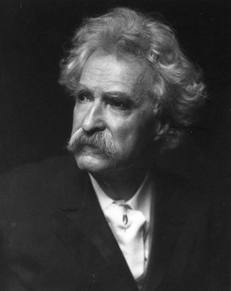

During our vacation last fall, I had an opportunity to visit the Mark Twain Museum in Hannibal, Missouri. I came across a personal letter written by Mark Twain in the early 1900's. Naturally, the sight of this letter stopped me dead in my tracks. My wife moved on leaving me there transfixed and captivated, leaning over the glass display case containing the letter. I studied it quite a while, made notes, and couldn't get it off my mind the rest of the trip home. I called the director of the museum, Mr. Henry Sweets, and he agreed to send copies of several of Mark twain's letters and notes.
Even if the author of these letters had been unknown, it was apparent that the handwriting belonged to a person of unusual literary capability. Indeed, it would have been difficult to have missed this person's occupation.
The strangest personal pronoun imaginable for a world renowned literary genius showed little ego (ego was expressed elsewhere, however) performed like a walking cane with a tiny circle at the beginning of the hook. You would expect an ego the size of all outdoors from reading his satires of kings, queens, and dignitaries. It brought to mind an inscription we had seen earlier at the base of his statue overlooking his beloved Mississippi River: "His religion was humanity and a whole world mourned for him when he died."
The size of his writing was rather small further attesting to his sincere humility, his marvelous concentration and attention to the myriads of detail so necessary to the accomplished writer. There are many word connections, words strung together in concentration so intense he could not get his pen away from the paper. He had no other thought than getting together his intricate planning of story plots and schemes.
The writing is superbly organized, spacing indicating the need of distance and time for deep and unrushed thought for prolonged meditation and consideration of the many profound interests of his life. Profound, yet laced with his famous dry wit.
Sam Clemens was no ordinary man, we know that for sure. Many people who write and write well have rather few indicators of literary talent in their writing. His writing is unmistakable and full of the scientific literary traits based on empirical research peculiar to the science of graphology. Most likely, he knew little or nothing of the science, which makes his writing a valuable study, reinforcing these scientific meanings of many graphological definitions. Obviously - from these accepted idioms of meaning - he was a person of the pen profession. Very noticeable is the lyric "d," a common stroke used by many literary artists. And, of course, he carried along his figure-eight kit, the "g" configuration used by those gifted for penning their thoughts well. These people have a little bag of tools all their own, a nifty little gift always there and energized when the proper time comes along. And, it helps when the imagination is so very fertile. The pressure of his writing is light allowing the mind to race and soar, exploring subjectively, not getting bogged down in the mire common to the over intense.
The "t" bars are launced above the stem -- lofty ideals transformed into common laughable scenes of children's everyday life. The worthwhile meaning and composition of Life itself espoused into the simple humanity of a midwestern river town where time stands still for barefooted boys and girls in the warm sunshine of life. Mark Twain was a specially blessed man and grew to recognize the distinct difference between glitter and true pristine values.
He has some traits that are almost detrimental to a writer; his connectedness, for instance, is extreme at times involving many connected words across an entire line. There is seldom a break in any word, even long ones, suggesting a restriction of creative thought and expression which is vital to the writer of successful fiction. Usually these formations are reserved for the reception of accepted logical concepts and often inhibit intuitive thought.
There are, to offset this seeming contradiction, many other areas in his writing that reveal these necessary traits.
Summary
Mark Twain was extremely complex, living in his world of contradictory impulses and urges, which he learned to correlate into his unique personal way of life and thought. When contradictory polarities are brought into cohesion and rhythmic focus, something remarkable has been created. In his case, a marvelous style of writing -- all his own -- fusing opposing forces within, into a single workable pattern of beautiful creativity.
How to phrase was not likely his larger problem. Of greater effort was bringing his kaleidoscopic interests and conflicts into a harmonious mind style. After that achievement came Tom Sawyer, Huckleberry Finn, and other titles we love so well.
Had I not wandered through that museum and by the dsiplay case, I would have missed getting better aquainted with this great man and the privilege of peering inside a mind admired and enjoyed the world over. Once having seen and studied his writing, it will be a long time before fading from my mind.
Even if the author of these letters had been unknown, it was apparent that the handwriting belonged to a person of unusual literary capability. Indeed, it would have been difficult to have missed this person's occupation.
The strangest personal pronoun imaginable for a world renowned literary genius showed little ego (ego was expressed elsewhere, however) performed like a walking cane with a tiny circle at the beginning of the hook. You would expect an ego the size of all outdoors from reading his satires of kings, queens, and dignitaries. It brought to mind an inscription we had seen earlier at the base of his statue overlooking his beloved Mississippi River: "His religion was humanity and a whole world mourned for him when he died."
The size of his writing was rather small further attesting to his sincere humility, his marvelous concentration and attention to the myriads of detail so necessary to the accomplished writer. There are many word connections, words strung together in concentration so intense he could not get his pen away from the paper. He had no other thought than getting together his intricate planning of story plots and schemes.
The writing is superbly organized, spacing indicating the need of distance and time for deep and unrushed thought for prolonged meditation and consideration of the many profound interests of his life. Profound, yet laced with his famous dry wit.
Sam Clemens was no ordinary man, we know that for sure. Many people who write and write well have rather few indicators of literary talent in their writing. His writing is unmistakable and full of the scientific literary traits based on empirical research peculiar to the science of graphology. Most likely, he knew little or nothing of the science, which makes his writing a valuable study, reinforcing these scientific meanings of many graphological definitions. Obviously - from these accepted idioms of meaning - he was a person of the pen profession. Very noticeable is the lyric "d," a common stroke used by many literary artists. And, of course, he carried along his figure-eight kit, the "g" configuration used by those gifted for penning their thoughts well. These people have a little bag of tools all their own, a nifty little gift always there and energized when the proper time comes along. And, it helps when the imagination is so very fertile. The pressure of his writing is light allowing the mind to race and soar, exploring subjectively, not getting bogged down in the mire common to the over intense.
The "t" bars are launced above the stem -- lofty ideals transformed into common laughable scenes of children's everyday life. The worthwhile meaning and composition of Life itself espoused into the simple humanity of a midwestern river town where time stands still for barefooted boys and girls in the warm sunshine of life. Mark Twain was a specially blessed man and grew to recognize the distinct difference between glitter and true pristine values.
He has some traits that are almost detrimental to a writer; his connectedness, for instance, is extreme at times involving many connected words across an entire line. There is seldom a break in any word, even long ones, suggesting a restriction of creative thought and expression which is vital to the writer of successful fiction. Usually these formations are reserved for the reception of accepted logical concepts and often inhibit intuitive thought.
There are, to offset this seeming contradiction, many other areas in his writing that reveal these necessary traits.
- There is intuitive instinct in his many threaded characters. Intuition is also a part of the figure-eight "g" formations which he uses throughout his writings.
- His light pressure and speed are unmistakable locations of sensitivity.
- The garland connections find him receptive to the concerns of the oppressed and needy, uncovering his soft and sympathetic heart.
- And, as mentioned earlier, the imagination shown by his high-above-the-stem "t" crossings. This famous man enjoyed the best of two worlds -- logically driven and intuitively blessed. What a marriage.
Summary
Mark Twain was extremely complex, living in his world of contradictory impulses and urges, which he learned to correlate into his unique personal way of life and thought. When contradictory polarities are brought into cohesion and rhythmic focus, something remarkable has been created. In his case, a marvelous style of writing -- all his own -- fusing opposing forces within, into a single workable pattern of beautiful creativity.
How to phrase was not likely his larger problem. Of greater effort was bringing his kaleidoscopic interests and conflicts into a harmonious mind style. After that achievement came Tom Sawyer, Huckleberry Finn, and other titles we love so well.
Had I not wandered through that museum and by the dsiplay case, I would have missed getting better aquainted with this great man and the privilege of peering inside a mind admired and enjoyed the world over. Once having seen and studied his writing, it will be a long time before fading from my mind.
Biography of Mark Twain
Background:
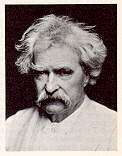
Mark Twain is a pseudonym for Samuel Langhorne Clemens
Twain was born in Florida, Missouri and lived from 1835-1910
His childhood was spent in the small Mississippi river town of Hannibal, Missouri
Thumbnail History:
Mark Twain spent his formative years in Hannibal Missouri where many of his novels are centered, most notably "The Adventures of Tom Sawyer" and "The Adventures of Huckleberry Finn". After the death of his father in 1847 he worked for his brother's newspaper in Hannibal, then was a wandering printer in many cities. In 1857 he went to New Orleans on his way to make his fortune in South America, but instead he became a Mississippi river pilot. His pseudonym was actually the river call for a water depth of two fathoms ("mark twain"). The Civil War ended river traffic and Clemens in 1862 went west to Carson City where his brother had been appointed territorial secretary. He failed in get rich schemes and turned to writing for the Virginia City Enterprise. Later he was a newspaper man in San Francisco. His first success was a short story, a masterpiece of western humor, "The Celebrated Jumping Frog of Calaveras County". When he returned from a trip to Hawaii, financed by the Sacramento Union in 1866 he first became a successful humorist lecturer. He also traveled in the Holy Land, the accounts of which were first published in "The Innocents Abroad". In 1870 he married Olivia Langdon of Elmira New York and settled down in Hartford Connecticut. Some critics have argued that his wife and her New England friends most notably William Dean Howells, thwarted his talents. Yet he wrote excellent works after his removal to Hartford, including his two signature novels "The Adventures of Tom Sawyer" and "The Adventures of Huckleberry Finn". Some of his later works are forced attempts at humor. His attitude changed later and was reflected in the distinctly bitter "The Tragedy of Pudd'nhead Wilson", even though he continued to produce humorous works. In the 1890's Twain made some bad investments and soon found himself deeply in debt. He continued to lecture around the world which led to his "Following the Equator" work. He also had to deal with the death of his two daughters and the long illness and death of his wife in 1904. Some critics think that the fierce pessimism of his later works were the result of his personal tragedy. This beloved American author will long be remembered for what many call the most "American" of authors.
Books and Articles Authored by Twain:
Two attempts at sequels to The Adventures of Tom Sawyer were also written. Letters he wrote can be found in "Mark Twain's Letters" 1917 Ed. A.B. Paine and "The Love Letters of Mark Twain" 1949 Ed. Dixon Weates and "Mark Twain's Letters to Mary" 1961 Ed. Lewis Lenry.
Other Links to Mark Twain websites:
Guest Analyst: Louie Seibert, CG
Mark Twain is a pseudonym for Samuel Langhorne Clemens
Twain was born in Florida, Missouri and lived from 1835-1910
His childhood was spent in the small Mississippi river town of Hannibal, Missouri
Thumbnail History:
Mark Twain spent his formative years in Hannibal Missouri where many of his novels are centered, most notably "The Adventures of Tom Sawyer" and "The Adventures of Huckleberry Finn". After the death of his father in 1847 he worked for his brother's newspaper in Hannibal, then was a wandering printer in many cities. In 1857 he went to New Orleans on his way to make his fortune in South America, but instead he became a Mississippi river pilot. His pseudonym was actually the river call for a water depth of two fathoms ("mark twain"). The Civil War ended river traffic and Clemens in 1862 went west to Carson City where his brother had been appointed territorial secretary. He failed in get rich schemes and turned to writing for the Virginia City Enterprise. Later he was a newspaper man in San Francisco. His first success was a short story, a masterpiece of western humor, "The Celebrated Jumping Frog of Calaveras County". When he returned from a trip to Hawaii, financed by the Sacramento Union in 1866 he first became a successful humorist lecturer. He also traveled in the Holy Land, the accounts of which were first published in "The Innocents Abroad". In 1870 he married Olivia Langdon of Elmira New York and settled down in Hartford Connecticut. Some critics have argued that his wife and her New England friends most notably William Dean Howells, thwarted his talents. Yet he wrote excellent works after his removal to Hartford, including his two signature novels "The Adventures of Tom Sawyer" and "The Adventures of Huckleberry Finn". Some of his later works are forced attempts at humor. His attitude changed later and was reflected in the distinctly bitter "The Tragedy of Pudd'nhead Wilson", even though he continued to produce humorous works. In the 1890's Twain made some bad investments and soon found himself deeply in debt. He continued to lecture around the world which led to his "Following the Equator" work. He also had to deal with the death of his two daughters and the long illness and death of his wife in 1904. Some critics think that the fierce pessimism of his later works were the result of his personal tragedy. This beloved American author will long be remembered for what many call the most "American" of authors.
Books and Articles Authored by Twain:
- 1865 "The Celebrated Jumping Frog of Calaveras County"
- 1869 "The Innocents Abroad"
- 1872 "Roughing It"
- 1873 "The Guilded Age"
- 1875 "Mark Twain's Sketches New and Old"
- 1876 "The Adventures of Tom Sawyer"
- 1880 "A Tramp Abroad"
- 1882 "The Prince and the Pauper"
- 1883 "The Adventures of Huckleberry Finn"
- 1883 "Life on the Mississippi"
- 1889 "A Connecticut Yankee in King Arthur's Court"
- 1892 "The American Claimant"
- 1894 "The Tragedy of Pudd'nhead Wilson"
- 1897 "Following the Equator"
- 1896 "Personal Recollections of Joan of Arc"
- 1899 "The Man That Corrupted Hadleyburg"
- 1905 "What is a Man"
- 1916 "The Mysterious Stranger" Published Posthumously
Two attempts at sequels to The Adventures of Tom Sawyer were also written. Letters he wrote can be found in "Mark Twain's Letters" 1917 Ed. A.B. Paine and "The Love Letters of Mark Twain" 1949 Ed. Dixon Weates and "Mark Twain's Letters to Mary" 1961 Ed. Lewis Lenry.
Other Links to Mark Twain websites:
- Mark Twain in his Times - University of Virginia [Stephen Railton]
- Mark Twain General Information and News Articles [Collected by Jim Zwick]
- Mark Twain Sites in Elmira, New York
- Photograph and Signature of Samuel Clemens/Mark Twain - University of Michigan [William Clements Library]
- Quotations: Orion - Tarleton State University [Barbara Schmidt]
- Quotations: Susy - Tarleton State University [Barbara Schmidt]
- Quotations: Olivia - Tarleton State University [Barbara Schmidt]
- Review of "Huckleberry Finn (Tom Sawyer's Comrade)" - University of Virginia
Guest Analyst: Louie Seibert, CG
